
Between Two Words - Ep 6 - Harold's Resolve
The Tapes


London, December, 1962.
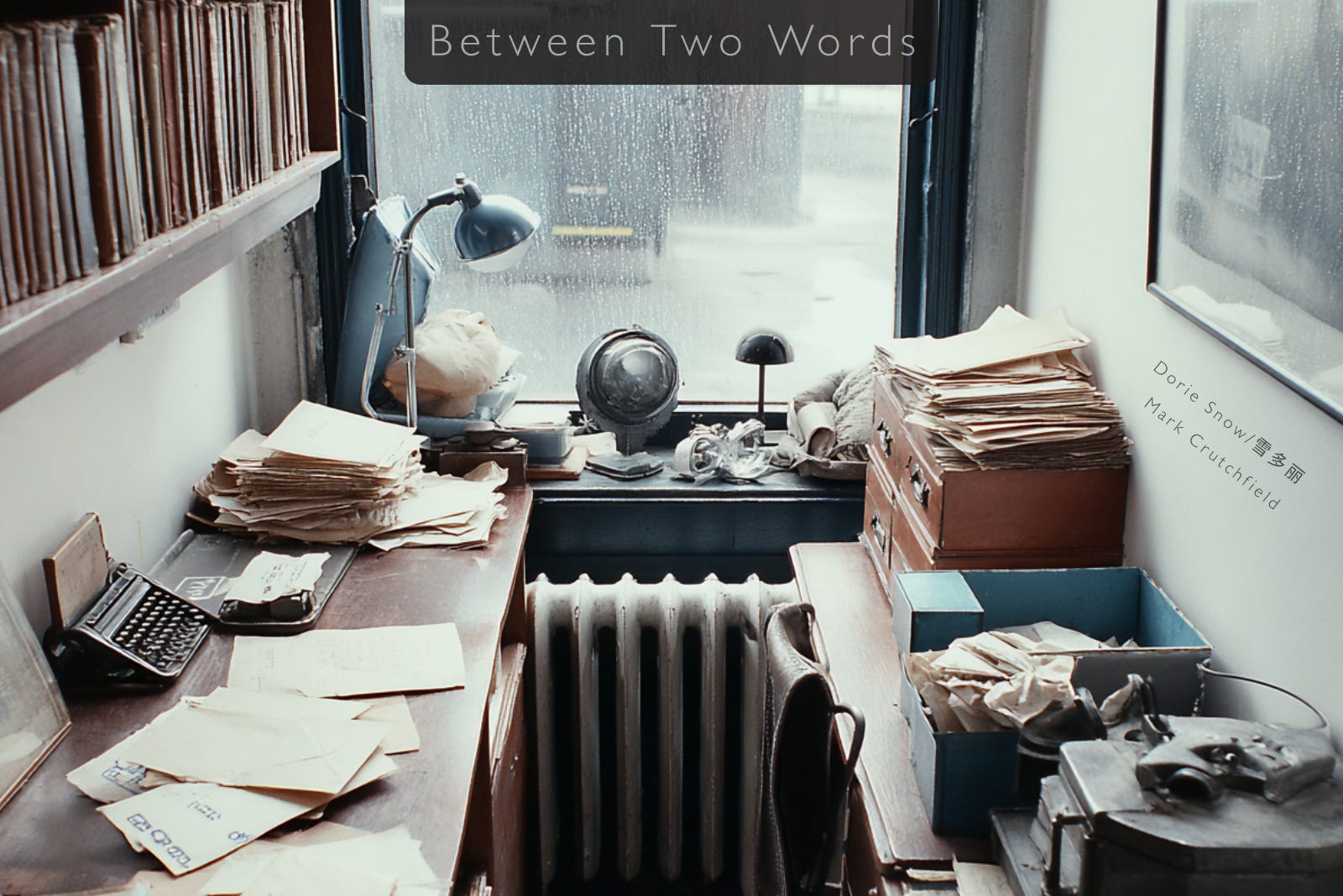
In the basement offices of the School of Oriental and African Studies, the air always carried a trace of damp paper and coal smoke. Even indoors, the city found its way in — soot settling on the window ledges, the low tremor of the Underground rolling beneath Bloomsbury like a distant pulse. The white enamelled radiators clanged more than they warmed, and wool coats never quite dried.
Upstairs, the corridors hummed with a different energy than they had only a few years before. Students lingered longer on the steps, voices sharper, newspapers folded beneath their arms — headlines still speaking in uneasy tones of missiles, borders, and distant tensions that had only recently stepped back from the brink. Authority was still present, but less unquestioned. Something was shifting — not yet a movement, not yet a declaration — just a restlessness that hung in the air like London fog.
Communication between London and Hong Kong moved slowly, carried not by voice but by ink and patience. A letter might take weeks to cross the world, passing through hands and sorting rooms before finally arriving where it was meant to be read. What reached its destination rarely belonged to the same moment in which it had been written. The seasons changed between sentences.
This is Harold’s next letter, written late at his desk beneath the university, the lamp burning long after the corridors above had emptied.
Dear Emily,
It feels as though centuries have passed since I last heard your voice or looked into your eyes, and yet I know it has been less than a year. I count the days — perhaps even the hours — between one letter arriving and the next, and that time is almost unbearable. I cannot imagine how people endured such separations before international post became what it is today.
Ah Fong has always held you in the greatest regard, and I suspect she understands more about how you feel than you perhaps allow yourself to admit. I remember her very well, especially how she looked after me when I sprained my ankle last year. She truly is a treasure, and she has always protected both you and our letters from your mother and father. Though from what you write, it seems your mother’s suspicions are growing stronger. Mothers often know far more than they ever say.
You made me laugh aloud when I read where you had hidden the pressed flowers. I daresay the flowers in my office leaned in to discover what had amused me so much.
The lies you need to tell, and the inspections your mother subjects you to, must be terribly exhausting when all you wish is happiness for everyone involved. I cannot help wondering why I am considered such an unsuitable husband. Perhaps it is because I am not working in the City — not in banking or shipping or some other profession your parents might deem more respectable. Or perhaps, quite simply, they do not care for me.
Yes, I still find myself walking past our old flat. I have no real reason to go that way, and I admit it brings a tear to my eye — though I suppose a man of my standing should not confess such things so freely. It is as though my legs know where they are going long before my mind catches up, as if my heart still believes that is where it is most needed.
Your story of Mei-Ling moved me deeply. For a child to show such courage after losing so much is remarkable indeed. Bravery appears in all ages and sizes, and often in the most unexpected places. I can understand, too, how caring for the children must give you strength while also asking something of your heart at the same time.
I know you feel a duty to remain where you are, my dear Emily. But how long must that duty bind you to a place where I cannot be by your side to care for you? I feel a duty too — to you, above all else. I know your heart is pulled in more than one direction, and I do not envy the weight of that choice.
Your mention of the banker’s son did not escape me. I cannot pretend the thought sits easily in my mind, though I understand the kind of future your parents believe they are arranging for you.
How I wish we could simply speak on the telephone. I miss your voice terribly — your laughter, your quick wit, and the gentleness with which you speak.
I remember that day in the Botanical Gardens as though it were yesterday, and how we walked home through the rain, drenched from head to toe, yet somehow warmed by what was quietly growing between us.
Christmas is approaching quickly here, though I cannot say I feel much joy in the thought of celebrating without you. It has never quite been the same since I lost my parents. Only when you were here did the season begin to feel truly alive again. Walking down Oxford Street to see the lights, skating in Hyde Park, chestnuts roasting on the corners — slipping one into each other’s mouths as we walked. Those are the memories I cherish most, but only because you were there beside me.
But I fear I speak too much of myself. Tell me more of the rebuilding after the typhoon. I imagine it will take a long time for everything to recover, and that many people are still suffering from the loss of family, possessions, and livelihood.
It seems increasingly clear that both your mother and father stand firmly against the idea of us being together. The only way I can see to resolve this may be for me to come there and speak with them myself. I know you are not keen on the idea, but I feel I must try to do something. Please reconsider my offer.
I must close now, but I look forward to your next letter more than you can possibly know.
Yours always,
Harold
ㅤ
If this felt like something you’d like to keep listening to,
subscribe to Dorie Snow/雪多丽 and to me to receive future exchanges as they arrive.
The last letter from Emily is here.
We’re both always open to thoughtful writing collaborations.
More pieces from Dorie Snow/雪多丽 (White Rabbit Musings)


Other prose and poems from me.


Nothing truly leaves — it just changes how it stays.
If something moved in you — a silence that whispered — I’d love to hear it below, or in my DM’s.
All artwork courtesy of NDjin Gallery
Mark what a lovely letter! The banker’s son is making Harold nervous? I think that was an intentional hint left by Emily to force you into action. Did you know bride stealing was a widely used practice in China? Especially if it involved feelings. The bride would be “kidnapped” during her wedding procession…
This is so good Dorie