
Between the Lines | Where tides go to speak
A different kind of shift

Most of the time, when I pull something apart, it’s because the poem isn’t holding.
This wasn’t that.
“Salt Before Language” was largely finished in its first full draft.
The shape was there.
The spine was there.
The sea was doing what it needed to do, and as we expect seas to do.
What followed weren’t structural changes; they were pressure adjustments.
Small ones.
But when I read the versions side by side, I could feel where the poem tightened — and where it stopped explaining itself.
That’s what this is.
Not a rebuild, but a refinement.
First, the published poem.
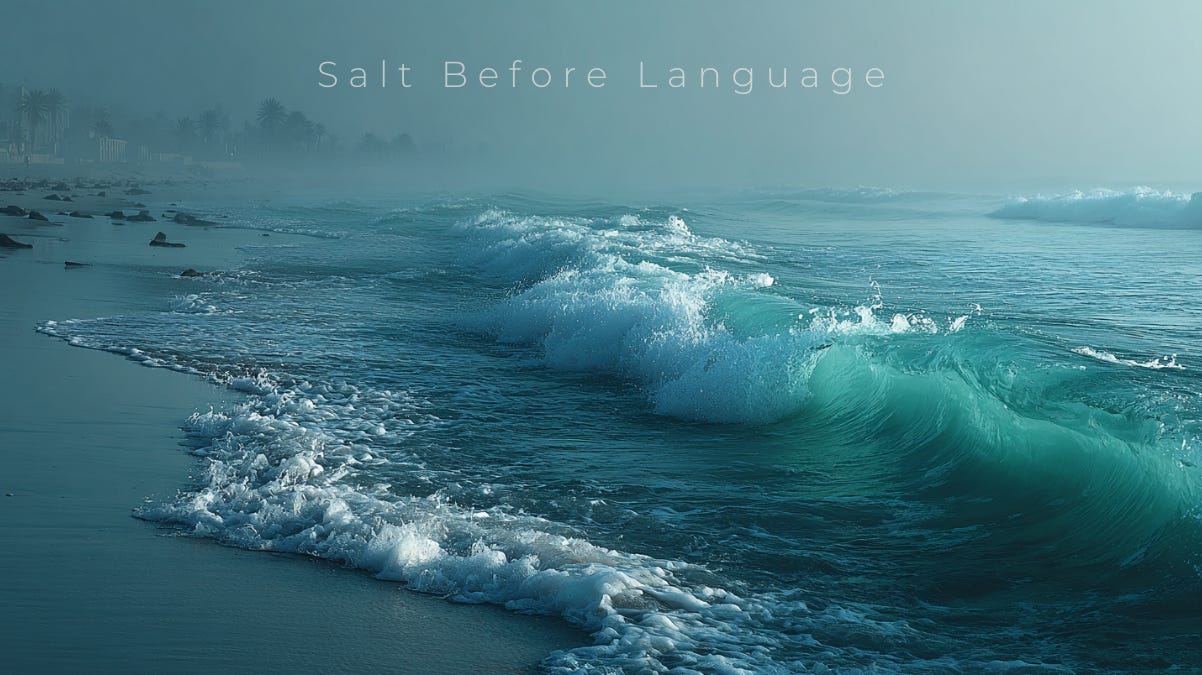
She came to see the sea,
but the sea saw she.
salt found her lips
before language could be
At the edge of the sea,
breathing brine and ease,
her chest learning rhythm
from the patient breeze.
The sea she chased
wasn’t blue — but bold,
a loosened knowing
she could almost hold.
Sea said: I keep what you won’t say.
She said: Your silence tastes this way.
Each wave returned
what tried to release,
a tongue-tied truth
it couldn’t quite cease.
Not spoken back,
not set at ease —
just held between
the mouth and the sea
ㅤ
🌊 Keeping the Body in Motion
In the first full and almost finished version, this stanza read:
her chest learned rhythm
from the patient wheeze.
In the next draft, I changed only one word:
her chest learning rhythm
from the patient wheeze.
I was feeling that “learned” closes the action.
It sounds complete — as if the sea has already done its work.
“learning” keeps the chest inside the process.
Still adjusting.
Still responding.
It’s a small shift in tense, but it changes the feeling of the line.
One version reports back.
The other breathes in real time.
Nothing about the image changes, only the motion.
🌬 Plugging the Leak
That same stanza carried another word that I felt didn’t quite belong.
Earlier versions ended with:
from the patient wheeze.
Later, it became:
from the patient breeze.
“wheeze” introduced something human and fragile, and almost clinical.
It pulled the sound inward, into the body in a way that narrowed the field.
“breeze” keeps the rhythm of the line, but restores the coast.
The air widens again.
The sea breathes like a tide, not a lung.
It’s the kind of word that can tilt a stanza without you noticing, until you read the versions side by side.
🗣️ Returning the Voice
There was another adjustment that I made that shifted the balance of agency.
Early drafts played with this line:
See said: Your silence tastes this way.
Later it became:
She said: Your silence tastes this way.
“See” keeps the line clever, and it leans into the pun, but maybe a bit too much
“She” brings it back to the body.
The poem becomes less about language noticing itself and more about presence speaking.
There was also a similar tightening here:
what she tried to release
became:
what tried to release
Removing “she” shifts the force outward, letting the tide become the actor.
The truth feels less like confession and more like pressure returning.
And then there was the ending in the earlier draft:
there was nothing more to see,
only something
that stayed.
It works. Yes. But it also explains.
It tells us what remains.
Later, that explanatory layer disappears entirely:
Not spoken back,
not set at ease —
just held between
the mouth and the seas.
No summary or knowing, and no interpretive closure.
Just something held.
PS. Note that later you’ll see that seas become sea in the final version.
By this point, a pattern had become clear: each revision was doing a similar thing:
Less explanation.
Less cleverness.
Less description and summary.
More contact. And that movement is what shaped the final tightening.
There was one final adjustment.
Earlier, the last line ended:
just held between
the mouth and the seas.
Later, it became:
just held between
the mouth and the sea
It felt like “Seas” widened the field too much.
It also felt vague, and maybe, almost mythic.
“The sea” brought it back to the shore she stood on.
Specific. Singular. Immediate.
The poem stopped gesturing outward, and it stayed where it began.
🌊 What the Tide Holds
Earlier versions ended like this:
And when she left the sea,
her body knew before she did —
there was nothing more to see,
only something
that stayed.
It works.
It closes the arc, and it reflects.
It also names what remains, where we see description creeping in — for which I do have a seemingly endless subconscious trait when writing, to over-describe, rather than let the image be created in the mind of the reader.
So for the later and final version, I decided to remove that exit entirely:
Not spoken back,
not set at ease —
just held between
the mouth and the sea
The difference for me here isn’t plot. It’s pressure.
The earlier ending explains the residue.
The later ending leaves it suspended.
There’s no “she left”, and no summarising knowing.
Just something held.
Between.
That shift does what many of the earlier micro-changes were already doing:
Less explanation.
More contact.
And, the poem stops describing what stayed, it lets us feel where it sits.
You might also notice the poem doesn’t end on a full stop.
That wasn’t accidental.
A period would have sealed it.
Settled it.
Leaving it open lets the line keep moving —
the way the tide
does
Not unfinished.
Just ongoing.
🪶 What Stays in the Body
This wasn’t a rebuild.
The first full draft already carried the poem.
What followed were adjustments in:
tense
breath
agency
tonal leakage
and closure
Small changes.
But each one altered how the body moves through the stanza.
That’s for me what tightening a piece of prose or poem feels like and how the process works, should you ever see me mention it.
Not louder, but quieter and sometimes softer.
Less clever, more held in the body.
🌾 Where This Might Go Next
The poem above began as a note.
A few lines left alone long enough to see what would happen when I posted it into the feed.
That posture keeps returning.
When something lands before you’ve decided what it means.
When repetition builds pressure without adding anything new.
When structure carries you further than explanation ever could.
Sometimes that movement is obvious, and sometimes it only alters the pace.
And sometimes you realise something has already shifted before you’ve found the language for it.
That isn’t something to resolve.
It’s the same cue as before and in previous Between the Lines posts:
Don’t rush it.
There’s more here.
In what familiarity does to attention.
In how intensity rises and falls on its own.
In how meaning arrives earlier — or later — than we expect.
For now, this is just a place to stop again.
Not to conclude, but to notice.
If you catch similar moments —
in reading, in writing, or elsewhere —
that’s often how the next piece begins to form.
ㅤ
☕ Staying With the Work
For those who choose to go a little deeper,
paid subscribers get
a monthly essay just like this one here
access to a Guided Noticing,
and occasional paid-only pieces.
Everything I publish publicly stays public.
This is about making space for slower work, and for people who want to stay close to how it’s made.
If you’ve been hovering, this is a good moment to step in.
ㅤ
— Mark
If you’ve just found yourself in this journey, you can find the start below.
And, a few more pieces from me…


Nothing truly leaves — it just changes how it stays.
If something moved in you, I’d love to hear it below, or in my DM’s.
All artwork courtesy of NDjin Gallery
This is wonderful! It’s so true how a simple and seemingly minor, but significant, edit can change how the poem breathes. Thank you for sharing this, Mark!
That was great. Hugely interesting.