
🧵 Between the Lines
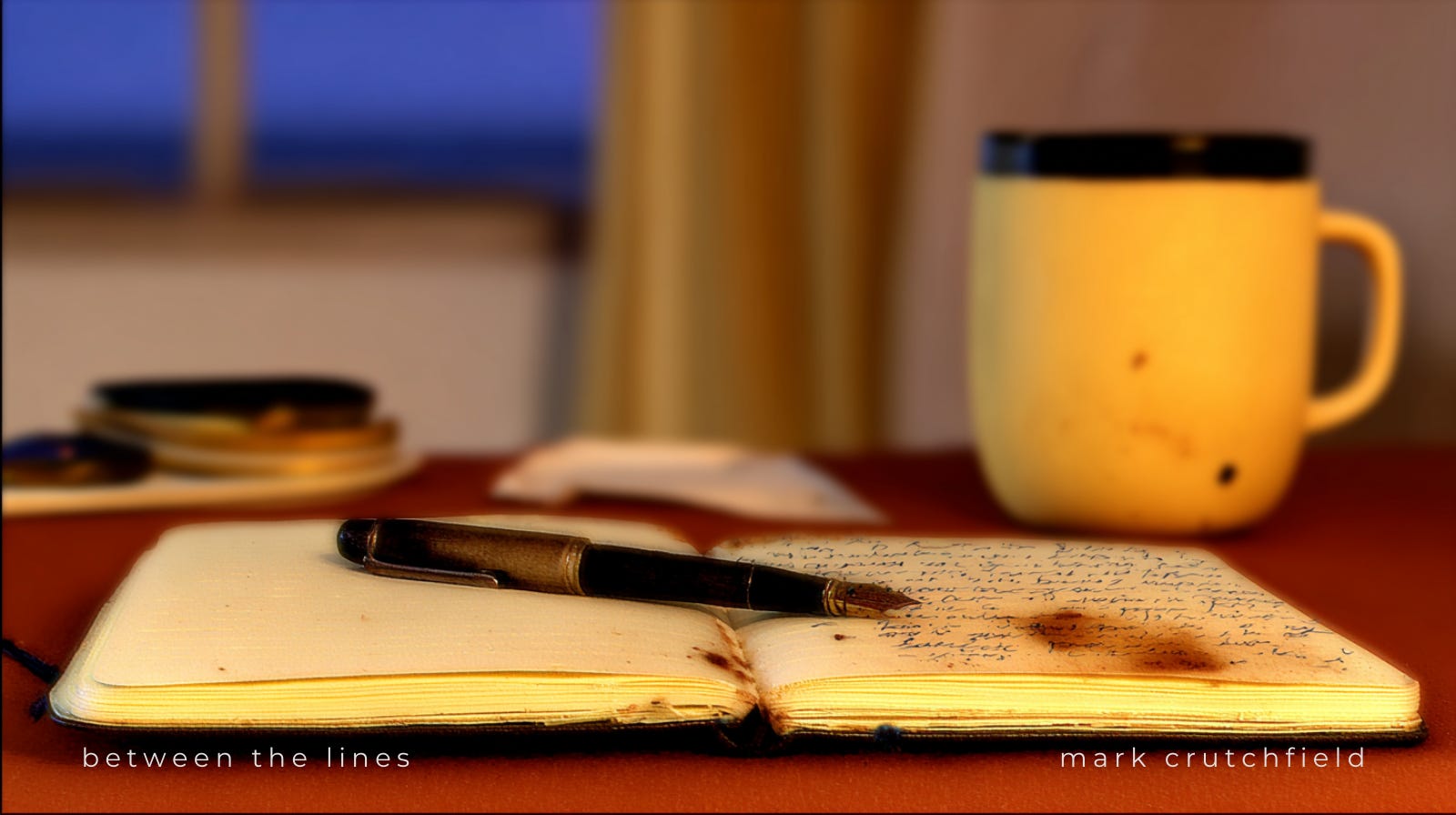
A practice for feeling what language does before you decide what it means.
Most writing teaches you something.
This series teaches you to understand what moves you in writing — why it moves you, where it moves you, and how to turn that into words.
It began as a simple frustration when I arrived here on Substack:
being moved by someone’s words, then finding all I could type was
“Beautiful post!” or “Loved it!”
as if that covered even a tenth of what actually happened inside.
So this became the experiment —
not a course, not really a method either,
just a slow, unhurried practice in recognition:
What shifted in your breath?
What image arrived, uninvited?
What softened?
What pushed back?
What stayed?
This is the series that helps you see the movement you usually skip past —
the stuff language does beneath meaning.
Everything else — Affective Semantics, Animacy, Reverse Narrative —
those have their own rooms.
This page is just the front door to Between the Lines.
☕ How to Read This Series
Treat each post the way you treat steam rising from a mug:
no rush, no agenda — just watch the shape of the thing until it tells you what it wants.
You don’t read this series for information.
You read it for movement.
You read it to understand the movement in you when you read.
That means:
read slower than you think you should
stop when your breath changes
scribble the line that caught you
don’t explain it yet — explanation kills early movement
return later and see what still hums
This isn’t literary analysis.
It’s not therapy.
It’s not performance.
It’s simply noticing what happens in you while the words move through you.
🔍 Core Ideas of the Practice
A few pillars — light enough to carry, sturdy enough to build on:
1. The Breathline
The sentence that changes your breathing before your brain catches up.
Your nervous system knows before you do.
2. Threads
The small repeats.
The recurring images.
What keeps returning in someone else’s writing — and your own.
3. Recognition > Understanding
Understanding is tidy.
Recognition is messy — and more honest.
It tells you why something landed, not simply what it said.
4. Form, Symbol, Voice, Function
Not analysis — just four soft angles for holding what moved:
Form
Symbol
Voice
Function
I’ll explain a bit more.
Form — the shape the sentence takes.
How it moves across the page: clipped, unfolding, breathless, broken, rhythmic.
Form is the part your body feels before you’ve even decided what the sentence means.
Symbol — the quiet signal beneath the sentence.
Not a metaphor, not “hidden meaning,” and definitely not literary decoding.
Symbol is the pull of an image — the thing the line evokes without naming.
It’s the doorway your mind walks through automatically:
a cup left untouched, a half-opened window, a chair pulled slightly away from the table.
These aren’t explanations.
They are invitations — small images that open larger rooms inside you.
Voice — the emotional temperature of the line.
The stance beneath the words: tender, watchful, resigned, sharp, playful, aching.
Voice is the quality you can feel even if you stripped the sentence down to bare verbs and nouns.
It’s the atmosphere you step into.
Function — what the line actually did to you.
Did it soften something? Ignite something?
Did it pull you toward a memory or push you against something you didn’t want to see?
Function is the effect — the movement left behind after the sentence has passed.
5. Replying From Inside the Line
The art of continuing someone else’s breath rather than applauding it.
Think of it like extending someone’s writing with your perspective —
without hijacking it into a monologue about your own life.
You’re not analysing their line.
You’re not retelling your autobiography.
You’re simply taking the feeling they opened
and walking it a few quiet steps further.
6. Public Threads Without Losing the Thread
Carrying the feeling into comments, replies, DMs —
without flattening it into “Great point!”
🗺️ The Posts (in order)
A quiet map of where you’ve been.
1. Let the Words Read You Back
Where it all starts.
Not with technique — but with the realisation that your body responds to writing long before your mind does.
2. One Line That Stayed With Me
A single sentence. A single breath.
A small initiation into tracking where language actually lands.
3. Three Sentences. Three Breaths. Try One.
Three different writers, three different openings.
You choose which path to follow — and you begin sensing your own recognition patterns.
4. You Feel It Before You Knew Why — How to Start Noticing What Moves You
The first real practice.
Learning to notice the micro-shifts — the breath, the pause, the quiet ache under the ribs.
5. The Shape of What Moves Us
Where the scaffold appears.
Form, Symbol, Voice, Function.
Not a framework — just a way of holding what your body already knows.
6. How to Reply From Inside the Line
Turning recognition into response.
Not interpretation. Not compliment.
Continuation — a shared breath carried forward.
7. How to Reply in Public Without Losing the Thread
Taking the practice into the wild.
Comment sections, threads, conversations — without sacrificing the felt sense.
Coming next.
🌿 What This Page Is (and isn’t)
This is the guide rail for the Between the Lines practice.
A quiet organising spine for a series that moves more like water than chapters.
It isn’t a course.
It isn’t a certification.
There isn’t even a stamp for completion, because you’re never really done — not with reading, or noticing, or whatever writing is becoming for you.
And this isn’t the place for the other techniques I explore — Affective Semantics, Affective Animacy, Reverse Narrative.
Those have their own halls.
This one is just the doorway where you learn to feel the floor shift under a single line.
This is the page you send people who say:
“I love this… but I don’t know where to start.”
Start here.
Then begin anywhere.
🪶 A Soft Closing Line
Every breathline is a door.
This series just teaches you how to notice when one opens.
You’re welcome to step through whenever you’re ready.
— Mark