
Before the Garden Code Forgot
The archived files.
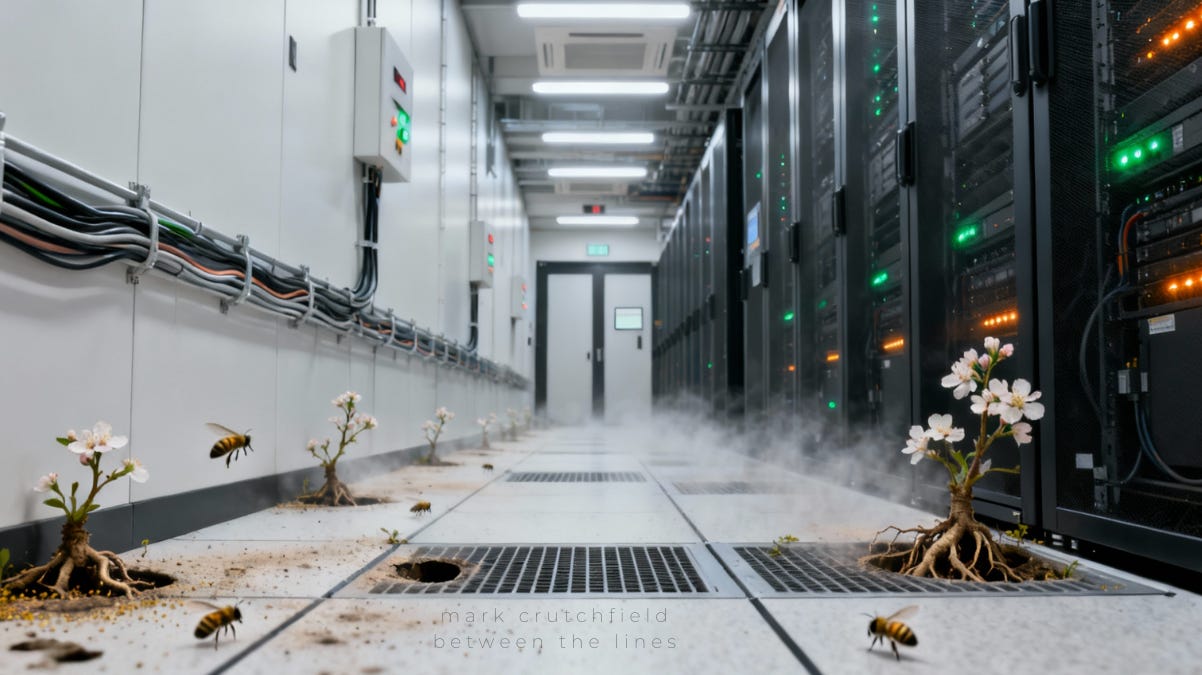
Roots kept the dark,
held passwords the system forgot.
Bees translate them back into bloom,
to feed the eternal digital rot.
Even algorithms crave
nectar.
The name floated in the air above me,
a hesitant breath as the sound slowly undoes,
a smell rising through the floor of my soul.
What grew there didn’t ask to be known,
only felt —
bone remembering bone,
stone remembering its home.
The garden kept time
the machines could not hold,
turning loss into loam,
and silence into gold.
Nothing was solved.
Nothing was saved.
But something old
was finally brave
enough
to grow.
It kept the dark,
held answers the system could not.
Another beginning.


Other stories and poems.


Nothing truly leaves — it just changes how it stays.
If something moved in you — a silence that whispered — I’d love to hear it below, or in my DM’s.
I’d also love to hear from you if you’d like to do a collab with me.
All artwork courtesy of NDjin Gallery
Wow those roots holding the passwords and the dark hold the answers ... So brilliantly written.. Awesome💛💛💛💛💛💛💛💛
Mark, you touched on a very important point. Our brain is constantly running old memories, even things from childhood. Just a week ago, I asked Grok what my channel's name was, and he couldn’t tell me. But when I reminded him, he remembered it for two days. Three months later, when I asked again, he couldn’t recall it.
After reading your piece, I did a little research on the human brain’s capacity, and here’s what I found: the human brain has about 86 billion neurons, each connected to thousands of others. Its long-term memory capacity is estimated at around 2.5 petabytes, which is enough to store the equivalent of 100,000 years of video. The fascinating part is that the brain doesn’t just store information, it organizes it, prioritizes it, and stores it based on emotions, which is why some memories disappear for a while and then suddenly return. Truly, the human brain is an almost limitless treasure, but how well we remember depends on emotions, repetition, and significance.