
Three Sentences. Three Breaths. Try One
Resonance isn’t universal. It’s personal. Let’s start there.

Between the lines – series 1, ep 3
🌫️ Breathing Through Someone Else’s Words
Last week, I asked you to notice the lines that stayed with you.
The ones that moved something in you before you had words for why.
This week, I followed that same thread.
A few readers shared lines that stayed with them.
I didn’t pick them for structure, cleverness, or literary merit.
I just read them.
Slowly.
Quietly.
And noticed what happened in me.
What I felt.
These three lines stand out.
Not for how they were written — but for how they move.
How they made me feel — and maybe moved something in you too.
So today’s post is less about insight, and more about recognition.
Less about technique, and more about breath.
About breathlines.
Less about reading to understand — and more about reading to feel.
I’ll walk through each of the three.
Just a few shortish thoughts on what they stirred in me.
No analysis. Just presence.
Let’s begin…
❄️ a girl in the snow - D.H. Lawrence
Last week, Moll Moonlight shared this line from a poem.
We were discussing the idea of breathlines from on the post, and she said — this is one that came to her:
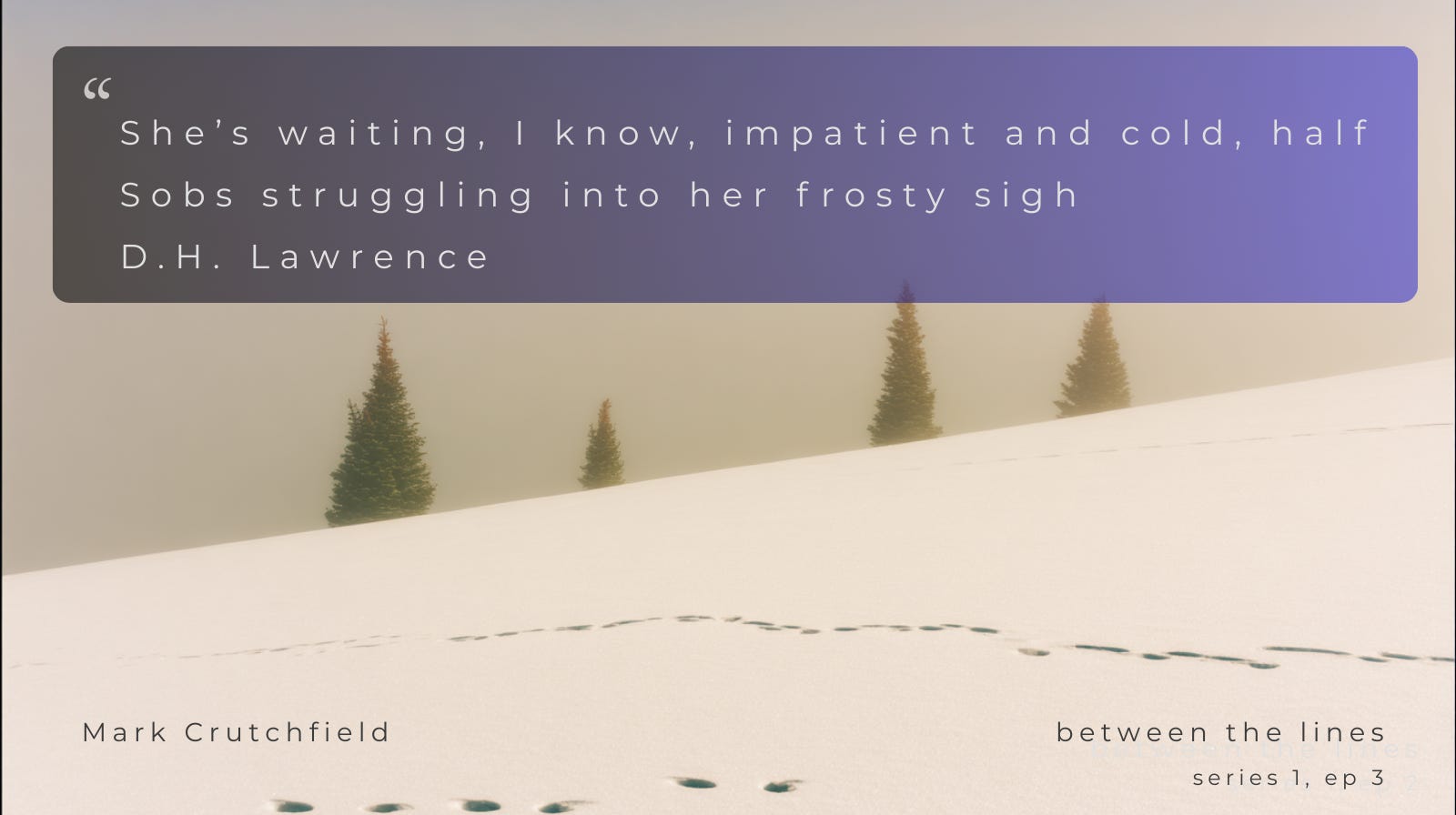
“She’s waiting, I know, impatient and cold, half sobs struggling into her frosty sigh.”
— D. H. Lawrence, A Winter’s Tale
I read it.
Then read it again.
And something in me gently stilled.
Maybe — even likely — not the same thing Moll felt.
But there was something felt in these words.
So I paused.
Not to analyse or dissect, but to notice.
To see where emotions are landing,
To notice how feeling is being held in breath, under the skin.
To sense what resonates, and where it takes you.
So I've captured a few notes below.
The lines felt like a breath held back — restrained, but full.
Not dramatic. Not loud. Just... tight.
There was emotion, but it wasn’t expressive.
It was stuck. Contained maybe.
The rhythm of the line mirrored that same feeling: broken, hesitant.
It didn’t move cleanly.
It staggered.
Like a sob that didn’t want to become sound.
And then I remembered that specific kind of ache.
The one where I wanted to speak, or cry, or move toward someone…
But instead? You just stand there. Numb.
Like seeing someone you once loved.
Soft, warm, familiar, And now — Distant. Cold. Already leaning toward someone else.
You don’t collapse.
You just… hold the breath in your chest and let the frost settle.
Side note: When writing this I used “numbed” at first.
But it just didn’t feel right.
It was too much of an effect — not a present feeling.
Even the sound of “-ed” felt harsher than the “mmm” in numb.
There’s no action in the lines.
There’s no release or resolution. Just a waiting…
And I think that’s why it hit me.
Because sometimes, the hardest feeling isn’t grief or anger.
It’s suspended longing.
That breath that almost becomes a sob — but doesn’t.
It’s the absence of closure.
The lack of grip that lets you move on.
I didn’t know I still remembered that feeling.
But the poem did.
You can read the full poem here: https://poets.org/poem/winters-tale
Did you feel this line or the poem unlocks anything for you?
🗝️ A knot unlocked - Eleni Rizopolou
Shared with me by Daniela Grothe and through last week’s exploration in breathlines, here's our second piece this week.
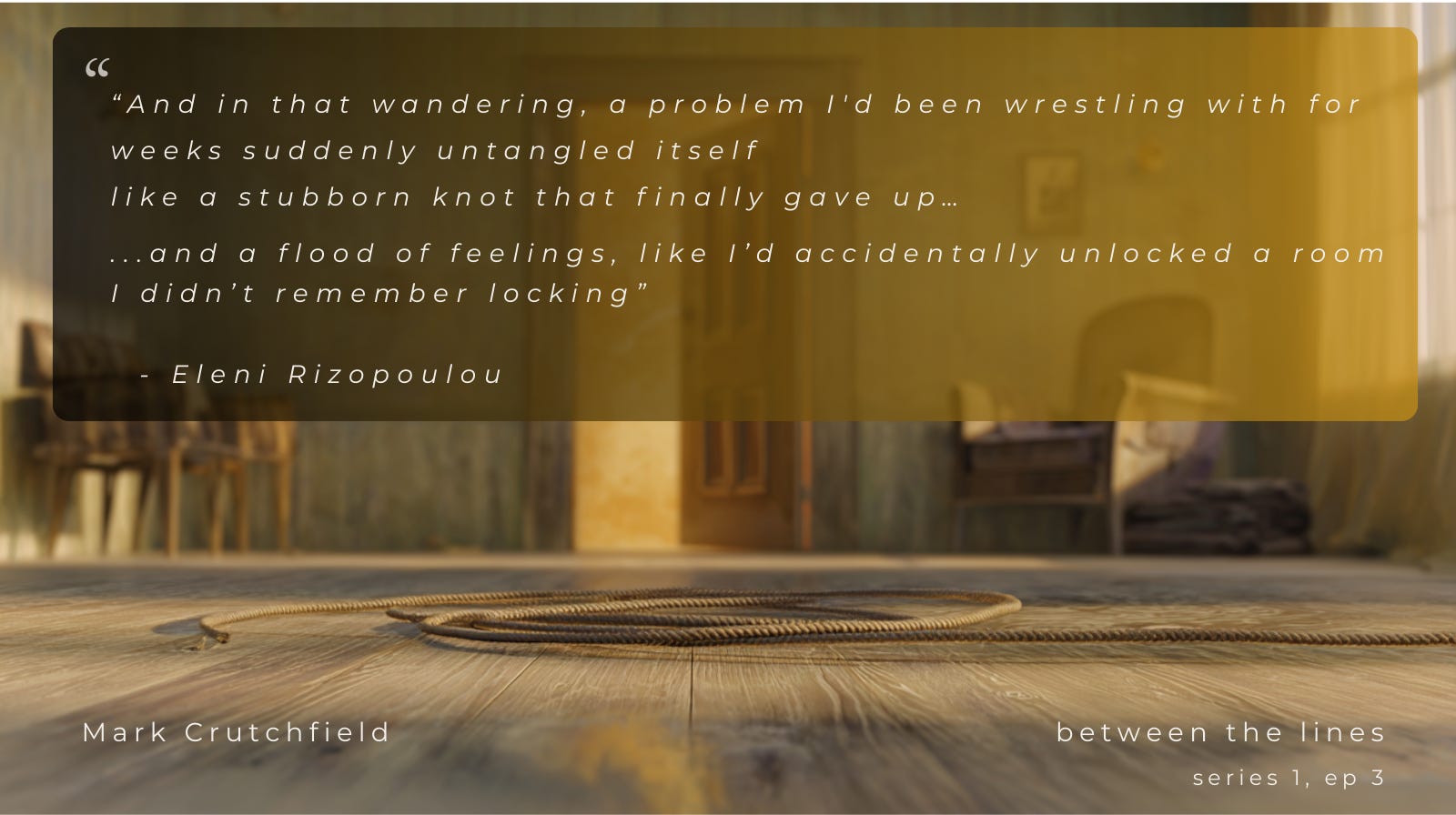
“And in that wandering, a problem I'd been wrestling with for weeks suddenly untangled itself like a stubborn knot that finally gave up…
… and a flood of feelings, like I’d accidentally unlocked a room I didn’t remember locking.”
As I was reading these lines, I was caught in the momentum of their flow.
It was as if there was movement here, but not toward anything.
At least not a fixed point of reference.
A kind of wandering with no destination — not aimless, just unpressured.
And somehow, that’s what lets something give way.
The tension wasn’t sharp — it had built over time.
Thoughts twisted, conversations knotted together, ideas pulling in different directions.
Like we all have at times. Sometimes frequently through each day, but always building. Weeks of mental struggle — until something loosened.
Nothing was solved. Just… opened. Maybe even released.
And with it, a flood — not of clarity, but of recognition.
We maybe even expected a resolution, but got a powerful shift instead.
Like stepping into a room you didn’t know existed.
You’re in it now — but you can’t yet see what it holds.
Sometimes we find ourselves standing in a space we didn't know was there,
Like opening a door into a room darkened not by light but a future we can't yet see.
And now.
Now we have a chance to make sense of it.
What did the door open for you? Did you feel a release or just a loosening?
You can read the full post by the brilliant Eleni Rizopoulou here:
What if I told you the cure for overthinking costs $0 and takes 5 minutes?
🪞 The White Album - Joan Didion
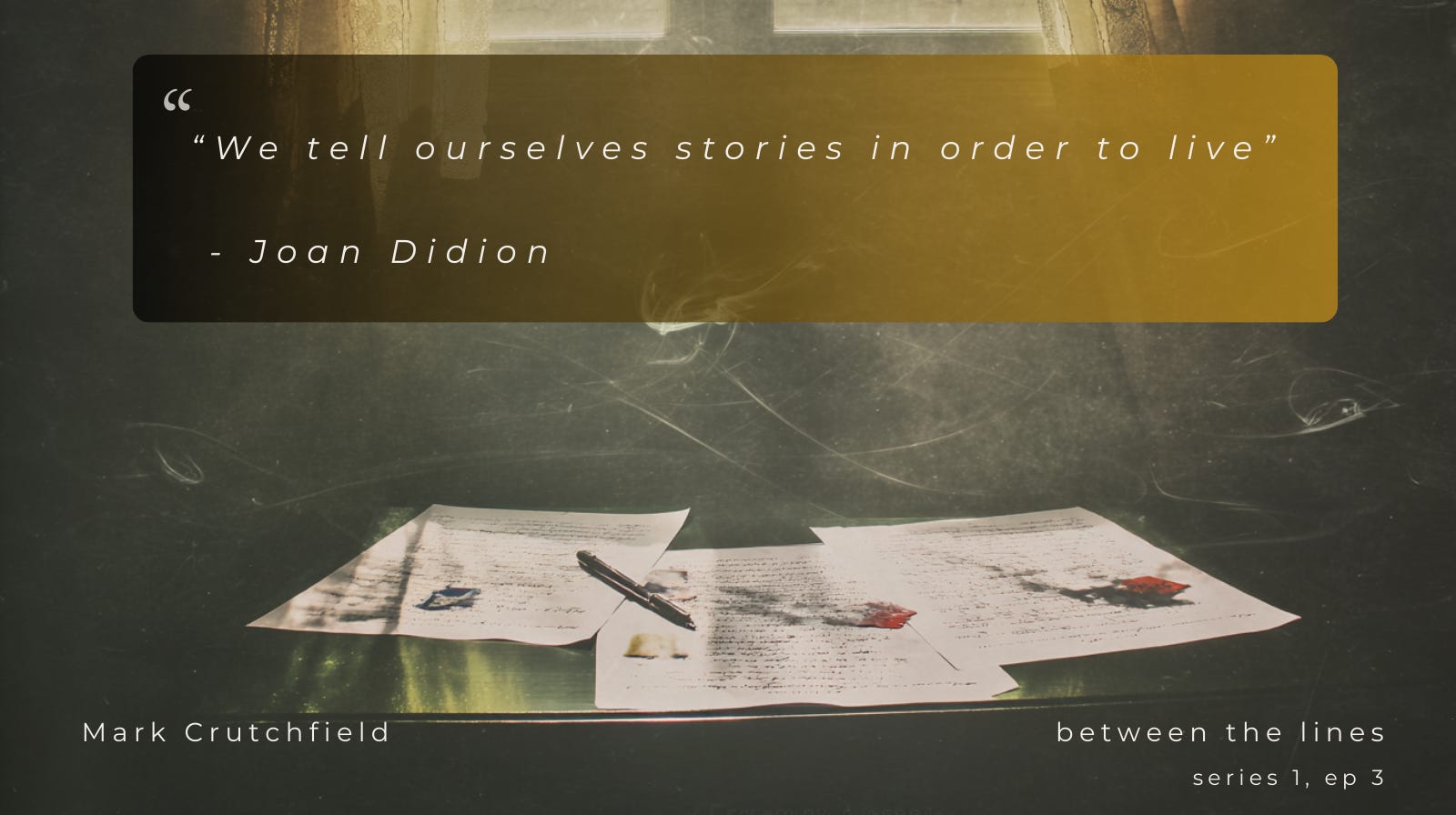
“We tell ourselves stories in order to live”
— Joan Didion, from The White Album (1979)
When I saw this again recently — after seeing it used, maybe even overused and clichéd many times —
It resonated.
Deeply.
I’ve been spending time writing recently, as most of us here do.
And through that, I’ve been deep in narrative.
But not with a pure focus on the stories themselves, although they are part of the journey.
I’ve been deep in the idea of what makes stories resonate with us — that we carry them forward as part of our own narrative.
How we can step into a story told well — be part of the narrative itself —
And begin to own it.
It’s something I call reverse narrative.
But I digress...
I used to think this line was just clever.
Something to throw out there to impress.
But now — Now I see it as quietly terrifying.
Because it’s not about fiction — it’s about survival.
The stories we tell ourselves,
About who we are
What happened
What it meant
Those become the air we breathe.
Some are oxygen.
Some are smoke — and the very things that can suffocate our growth.
Our lives, even.
This line makes me wonder:
What stories am I still living inside, without realising I wrote them?
🌬️ Three Breaths Later
So that’s where I ended up this week.
Three lines. Three different people.
Three different kinds of movement.
And a post much longer than I had planned.
One held a breath in.
One released it.
One made me wonder what stories I’m still breathing in — without realising I wrote them.
Huge thanks to Moll Moonlight and Daniela Grothe for sharing the first two lines.
Both took me somewhere I didn’t expect — into writing I’d never read before, and more importantly, never felt before.
This whole post became something I didn’t plan. I had other writers planned, but the lines you shared needed to take the stage, and for good reason.
It’s been a reflection through other people’s words.
That alone feels worth noticing.
🧶 What This Is (And What It’s Becoming)
This isn’t a practice of analysis.
Or structure.
Or even writing, really.
It’s a practice of feeling through language —
and noticing when something inside you shifts.
The breathline was just the beginning.
What I’m starting to see now is that recognition lives in all kinds of places:
The ache of something unfinished
The soft click of something unknotted
The quiet shock of a story that turns out to be your own
💬 If You Want to Carry This Forward
This post wasn’t about finding answers.
It was about feeling what lands — and letting the language move you.
But maybe this week, you try this:
1. Choose a single sentence from something you're reading
(a book, a post, a comment — anything)
2. Don’t explain it.
Just sit with it. Let it echo a little.
3. Ask yourself gently:
What part of me did this touch?
What did I feel before I understood it?
Did something loosen, ache, or rise in me?
That’s it.
That’s the whole practice.
📜 Next Episode:
Post 4 — Begin Anywhere: How to Start Noticing What Moves You
We’ll explore the early steps of reading with feeling.
Not through analysis, but through attention.
Not by solving a sentence — but by noticing where it moves you.
No structure. No jargon. Just some of the things I’ve been finding as I’ve been exploring this alongside you.
And a gentle way to start noticing what breathes inside the words you already love.
🌀 Thanks for being here for the series:
🎞️ First episode: where this story started

🎞️ Second episode: where we learned about breathlines and the lines that linger after the page has turned

☕️ These posts land on Sundays.
Not for skimming — for savouring.
I’ll bring some coffee.
You bring the curiosity.
I’ll be here.
— Mark
If something moved in you — a line, a moment, a breath — I’d love to hear it below, or in my DM’s.
This isn’t just a post. It’s part of a silver thread.
P.S. Each week, instead of supporting me, I spotlight a different writer who deserves your attention — and maybe a coffee or a subscription too.
Scroll down to the comments to meet this week’s, starting each Sunday.
This post ended up being slightly longer than planned, but for good reason.
The lines shared by Daniela and Moll really resonated, and when that happens, I like to go a little deeper.
Not just to appreciate, but to learn why I paused, felt the shivers, was reminded of a breakup a long time ago, and how some words can just move us.
Often we feel that moment, appreciate it, and put it down to the brilliant skills of the writer, but there's something deeper here I'm realising.
- By taking time to pause, we learn, not just about the writing itself, but about us
- By writing about how we feel with the words, I find I can write just a bit better, and maybe a bit more from felt presence — even somatically
And that's one of the reasons I started this series — not just to learn, but to share this as I go.
And what you see here, is what I'm also putting into practice when I leave comments on as many great writers as I can on this platform. So many people put their heart and soul into sharing their words, it feels important to offer more than just ‘Great post'.
Keep following and sharing your experiences on the way, and we can all learn and grow together.
In a departure from my usual note, I’d love to point your attention elsewhere.
ㅤ
This week’s between the lines piece was sparked by a line shared by @Moll Moonlight, whose writing deserves not just to be read — but to be felt and noticed.
There’s something in it that bypasses analysis and just… lands.
ㅤ
She doesn’t have a “Buy Me a Coffee” link, but she does have a Substack — full of what she calls “steamy historical femme scribbling in the shadows.” I can’t do it justice here — just go read it.
ㅤ
Here’s the latest piece:
👉 Taken by the Highwayman (Chapter 3, Part 3)
https://open.substack.com/pub/mollmoonlight/p/taken-by-the-highwayman-1ff
Let yourself be pulled in.
She’ll take it from there.